Curtain Wall vs. Window Wall: A Specifier's Guide for Mid-Rise Aluminium Projects

The short version
Curtain wall hangs in front of the slabs as one continuous façade; window wall sits between them, one floor at a time. Curtain wall favours performance and continuous glazing; window wall favours speed and cost on regular mid-rise grids.
Curtain wall
Hangs in front of the floor slabs as one continuous façade.
Best for
- Continuous, multi-storey glazed façades
- Premium envelopes without slab-edge bridging
- Office, institutional & premium residential
Window wall
Installed between the floor slabs, one storey at a time.
Best for
- Mid-rise residential & mixed-use
- Regular structural grids on a developer budget
- Projects that need operable windows
At a glance
| Criterion | Curtain wallHangs in front of the floor slabs as one continuous façade. | Window wallInstalled between the floor slabs, one storey at a time. |
|---|---|---|
| Structural attachment | Hangs off the slab edge — independent of the floor structure. | Sits between slabs — relies on the floor above and below. |
| Typical span | Multi-storey, continuous. | One floor at a time. |
| Thermal bridging risk | Lower — continuous thermally broken profiles across the façade. | Higher — every slab edge is a potential thermal bridge. |
| Fire-stopping | Required between floors — adds cost and coordination. | Largely inherent to the slab-to-slab geometry. |
| Operable units | Typically fixed glazing with discrete vents. | Integrates operable windows more easily. |
| Installation | Engineered anchors and multi-floor assembly. | Simpler and faster — dropped in slab by slab. |
| Upfront cost | Higher. | Lower. |
| Best fit | Office, institutional, premium residential, continuous glass façades. | Mid-rise residential, mixed-use, budget-conscious projects. |
You're in design development on a six-storey mixed-use building. The developer wants floor-to-ceiling glazing, the structural grid is set, and the question lands on your desk: curtain wall or window wall? On a rendered elevation the two look almost identical. In the field — and on a performance spec — they behave very differently, and choosing the wrong one creates problems that surface at tender, at permit, and at the commissioning blower-door test.
The short answer is in the table above. Here's the reasoning behind it, so the decision is defensible and code-aware.
What each system is
A curtain wall is a non-load-bearing exterior façade that attaches to the outside face of each floor slab. It hangs from anchors and acts independently of the building structure, so a single engineered assembly has to accommodate building sway, thermal movement, and multi-floor wind loads. Aluminium framing is standard, either stick-built (mullions and transoms assembled on site) or unitized (factory-assembled panels craned into place). Stick suits irregular geometry and lower volumes; unitized reduces site labour and improves factory-controlled quality on repetitive work.
A window wall is installed between the floor slabs — slab to slab — rather than in front of them, and is supported by the concrete above and below. Panels are typically prefabricated and dropped into each opening in sequence. Window walls are popular on residential and mixed-use mid-rises precisely because the installation sequence is simpler, fire-stopping is largely inherent to the geometry, and upfront cost is lower.
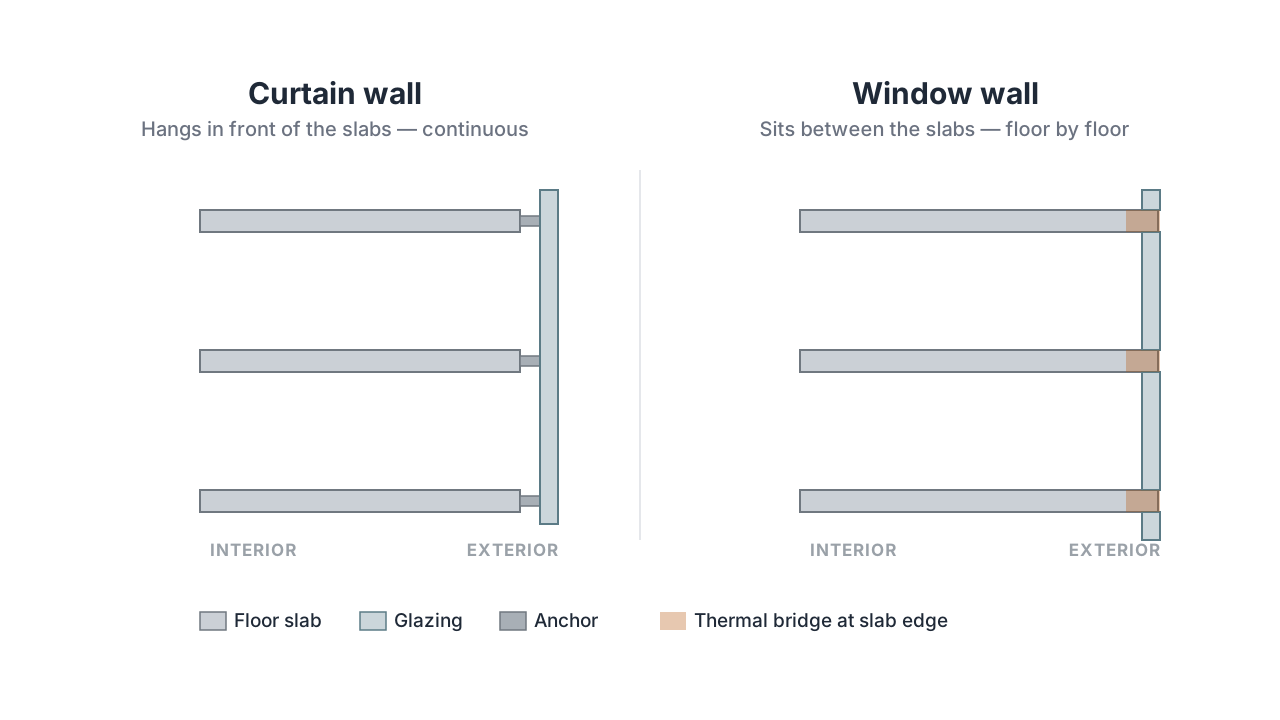 The core difference: a curtain wall runs past every slab; a window wall sits between slabs, so each slab edge meets the glazing as a potential thermal bridge.
Where they differ in practice
The at-a-glance table summarizes the trade-offs; the ones that drive most decisions are thermal bridging, fire-stopping, and cost. A curtain wall controls thermal bridging at the system-design level, before anything reaches site, because a thermally broken profile runs continuously across the façade. A window wall reintroduces the building structure into the glazing plane at every storey, so its real-world performance depends heavily on how the slab edge is detailed.
Neither is universally superior. The right answer depends on building height, structural layout, programme, and performance targets.
Thermal performance and the Canadian code context
This is where the choice has real consequences, especially in cold climates. Canadian energy codes require thermal breaks in metal fenestration framing, and that applies to both systems — but the execution differs.
In a curtain wall, the continuous thermally broken profile does most of the work. In a window wall, every slab edge is a potential thermal bridge: the concrete floor intersects the plane of the glazing at every storey. Without deliberate detailing — insulated spandrel panels, edge-of-slab thermal breaks, and continuity of the air barrier — a window wall can perform noticeably worse than its centre-of-glass U-value suggests.
Whole-assembly thermal performance, not centre-of-glass, is what gets evaluated on a performance path. Verify actual U-values and energy ratings at the system and configuration level against the current requirements published by Natural Resources Canada and the applicable building and energy codes for your jurisdiction. Published data reflects tested assemblies under specific conditions; real performance depends on system depth, glazing, thermal-break geometry, and installation quality.
How NAFS applies to façade assemblies
A common error is to spec a façade by building type alone. Note the scope of the standard: the AAMA/WDMA/CSA 101/I.S.2/A440 (NAFS) performance classes — R, LC, CW, and AW — apply to windows and doors. Curtain wall and window wall are evaluated instead as Other Fenestration Assemblies, and are specified to a performance grade matched to the project's wind load, water-penetration resistance, and structural requirements.
So the right move isn't to pick a "class" off the building's height — it's to establish the required performance grade for your specific location and exposure, then confirm the assembly is tested to meet it. On an exposed coastal or lakefront mid-rise, loads can be higher than the building's nominal height would imply. Establish minimum performance requirements by location and height before products are selected, not after.
A word on aluminium
Both systems are typically aluminium-framed, for good reason: aluminium is dimensionally stable, corrosion-resistant, accepts durable factory finishes, and works with the full range of glazing and panel infills. It's also fully and infinitely recyclable, and recycling it uses only a small fraction of the energy needed to produce primary aluminium (see the International Aluminium Institute for current figures). For projects tracking material circularity, that's a genuine, verifiable attribute.
Our take
Neither system is better in the abstract — the choice is structural, thermal, and constructability-driven, and it belongs in design development, not at tender.
- Continuous glazing across slabs, multi-storey spans, or a premium envelope without slab-edge bridging → curtain wall.
- Mid-rise residential on a regular structural grid, a developer-driven budget, and operable units → window wall, provided the slab-edge thermal detailing is addressed early.
Either way, confirm the target performance grade and the whole-assembly thermal performance before you select a system — not after.
Frequently asked questions
- What is the main difference between curtain wall and window wall?
- A curtain wall hangs in front of the floor slabs as one continuous, multi-storey façade that is independent of the building structure. A window wall sits between the slabs, one storey at a time, and is supported by the floor above and below.
- Which is cheaper, curtain wall or window wall?
- Window wall is generally lower in upfront cost. Its slab-to-slab geometry simplifies the structure, installation, and fire-stopping. Curtain wall costs more because of engineered anchors, multi-floor assembly, and inter-floor fire-stopping — but it suits continuous glazing and higher-performance envelopes.
- Is window wall worse for thermal performance?
- Not inherently, but it carries more risk. Every slab edge is a potential thermal bridge, so window wall depends on deliberate detailing — insulated spandrels, edge-of-slab breaks, and air-barrier continuity. Assess whole-assembly performance, not just centre-of-glass, for either system.