When Does Window Selection Enter Project Planning? A Phase-by-Phase Guide

Window selection is not a last-minute tender detail. It is a sequence of decisions that starts at concept — performance intent and budget — and hardens in design development, when the structural grid, facade modulation, and performance grade are known enough to specify a system with confidence. Leave the big calls until bid stage and you trade flexibility for cost, schedule, and compliance risk.
Here is how fenestration and facade system selection typically maps onto project phases on Canadian mid-rise and commercial work. Adjust for your delivery model (design-bid-build, design-build, or fast-track), but the order holds.
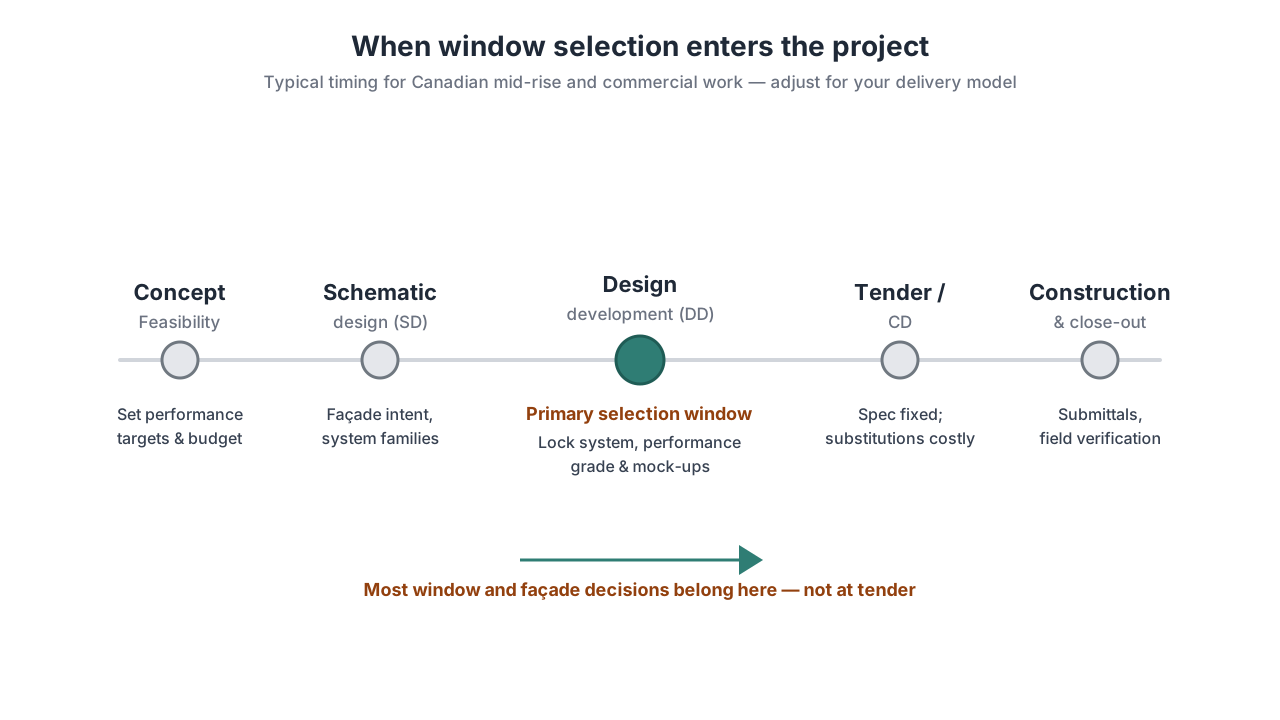 Design development is where system family, performance targets, and mock-up scope should be locked — before the spec goes to tender.
Concept and feasibility — set direction, not products
At concept, you are not picking a catalogue section. You are agreeing on:
- Performance intent — target energy performance, acoustic privacy, operability expectations, and whether the envelope is prescriptive or performance-based.
- Budget envelope — a realistic allowance for glazing and framing as a percentage of envelope cost, informed by programme and height.
- System families — punched openings vs continuous facade; residential window wall vs office curtain wall — at the level of "what kind of building is this?"
This is the right moment to flag Quebec or energy-program constraints (for example whether ENERGY STAR–listed products will be required) and to link out to program authorities rather than interpret code in a supplier voice. If the project is mid-rise residential with a regular grid, window wall may be the default economic path; if the elevation is continuous glass, curtain wall belongs in the conversation early — see our curtain wall vs window wall guide when that fork appears.
Schematic design (SD) — facade intent and the big fork
Schematic design is where the elevation becomes legible: window-to-wall ratio, typical floor heights, balcony or slab-edge conditions, and whether the facade is modular or continuous. Decisions that belong here:
- Opening rhythm and structural implications — how glazing relates to the grid; where spandrel zones hide structure.
- System family shortlist — window wall, stick curtain wall, unitized curtain wall, or hybrid punched window + spandrel panels.
- Early performance targets — not final U-values, but whether triple glazing, warm-edge spacers, or enhanced acoustic assemblies are in scope.
You still should not lock a manufacturer-specific spec, but you should eliminate incompatible families. Choosing curtain wall after the team has sized the structure for punched openings — or the reverse — is a common source of redesign.
Design development (DD) — the primary selection window
This is where window and facade selection should land. By design development you have:
- Confirmed floor-to-floor heights and typical opening sizes
- Structural support and slab-edge geometry understood
- Wind exposure and required performance grade for the location
- Enough detail to compare systems on thermal, acoustic, and constructability grounds
Work that belongs in DD:
- Select the system family and configuration — including thermal-break geometry, operable vs fixed mix, and spandrel strategy for window wall.
- Set performance requirements the spec will enforce — air/water/structural targets appropriate to the assembly type (remember: NAFS class ratings apply to windows and doors; curtain wall and window wall are evaluated as Other Fenestration Assemblies — our comparison guide explains the distinction).
- Plan mock-ups and testing scope — laboratory or field mock-ups for critical details, especially slab-edge conditions on window wall.
- Coordinate with interiors and MEP — sill heights, blinds, ventilation, and fire-stopping interfaces.
If DD closes without a defensible system choice, tender becomes a pricing exercise on an under-defined envelope — and substitutions become the only way to recover performance, at a premium.
What this means for your project Treat design development as the deadline for fenestration selection — not the bid date. Bring the envelope consultant, structural engineer, and a technical partner into DD reviews while changes are still cheap.
Tender and construction documents — lock the spec
Tender documents should describe a selected system approach, not a shopping list of interchangeable products. At this stage:
- Performance requirements, test standards, and submission requirements are fixed.
- Alternates and substitutions are controlled — "or equal" language without a basis of design creates ambiguity.
- Drawings show typical details, anchorage zones, and interface sequences.
Changes are still possible, but each one ripples through pricing, shop drawings, and often permitting. "We'll figure out the window system in construction" is how air-barrier failures and condensation callbacks start.
Construction and close-out — verify, don't redesign
During construction, selection gives way to verification:
- Submittals demonstrate the specified assembly meets the performance grade and test evidence cited in the spec.
- Mock-ups prove water management and thermal continuity at slab edges and head/sill conditions.
- Field reviews confirm installation matches the tested configuration.
This is not the phase to swap system families. It is the phase to hold the line on what was selected in DD.
Questions to settle before you write the spec
Use this checklist in design development — not at tender:
- Which system family matches the structural grid and elevation intent?
- What performance grade and whole-assembly thermal targets apply to this site and exposure?
- Where are slab edges, spandrels, and operable units — and who owns the thermal detail?
- Are mock-ups or laboratory tests required before bulk fabrication?
- Who holds the spec — architect, consultant, or design-build contractor — and how will substitutions be controlled?
For laboratory testing context and certification programs that may apply by configuration, see our certifications hub. For project-specific confirmation, contact our technical team.
Related reading
Frequently asked questions
- When is the best time to choose a window or facade system?
- Design development (DD) is the primary window for selection — after the structural grid and facade intent are set, but before the specification is locked for tender. Early concept work should set performance targets; tender is too late for major system changes without cost and schedule impact.
- Is it too late to change window systems at the tender stage?
- Major system changes at tender are possible but expensive. Substitutions after the spec is issued usually trigger revisions, re-pricing, and sometimes re-permitting. If the wrong system family was chosen earlier (for example window wall where continuous curtain wall was needed), the fix belongs in design development, not at bid.
- Who should be involved when windows are selected?
- At minimum: the architect, envelope consultant or specifier, structural engineer (for loads and slab-edge detailing), and the owner or developer on performance and budget. Early involvement from a supplier or technical partner helps confirm what is buildable before the spec is written.
- Can you select windows before the structural grid is fixed?
- You can set direction — system family, approximate performance targets, budget envelope — but not the final specification. Opening sizes, structural support, and slab-edge conditions all depend on the grid. Selection hardens once schematic design confirms floor-to-floor heights and facade modulation.